
DISPERSION IS THE STORY OF THE DAY
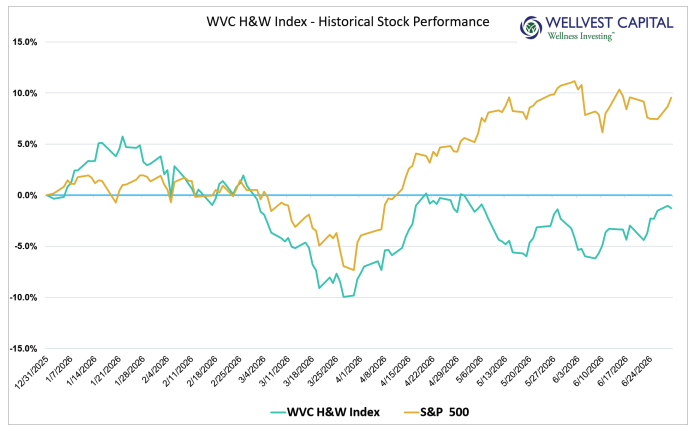
On the surface the WVC Health & Wellness Index was close to flat, only down 1.3% on an equalweighted basis over the six months ending June 30, 2026 while the S&P 500 climbed 9.6% (both figures excluding dividends). But for the WVC H&W Index, what lies beneath these placid results warrants caution and some reflection. During the last six months the H&W Index had significant bifurcation of winners and losers. Twenty-three constituents rose while twenty-six fell. The
spread ran from the notoriously volatile Laird Superfood (LSF), up 111.7%, to Vital Farms (VITL), down 63.6%, after a strong 2025. The story of H1 2026 is not the average, it is the distance between the winners and the losers, and the dividing factors.
One additional data point reinforces this observation. The WVC H&W Index is calculated on an equal-weighted basis by design, to give the sector’s many micro-cap and small-cap names an equal footing alongside their larger brethren. On a “market-cap-weighted” basis the index actually gained 2.0% in H1, as the large cap names like Nestlé (SWX:NESN), Garmin (GRMN), and DSM-Firmenich (AMS:DSFIR) outperformed. The gap between the equal-weighted, down 1.3% and market-cap-weighted, up 2.0% drives this home. In H1, scale, quality, and profitability were rewarded; sub-scale and speculative story stocks were not.
The broad market’s own path was anything but smooth. After bouncing along in a narrow range of about zero to up ~3%, a late first quarter, technology-led selloff dragged the S&P 500 negative on the year with a large impulse wave down in March to bottom out 7.3% down for the year as of March 30. A powerful spring recovery carried the index to a 9.6% gain by June 30. Even with the added volatility, the S&P 500 spent most of the first half of the year outpacing the Wellvest H&W Index. At June’s end, the gap was a meaty 10.9%.
QUALITY IS REWARDED
One theme had more impact on the H&W Index than any other: the market paid up for quality, profitable, organic, margin-accretive growth and stopped paying for the promise of better days for many of the players in once-hot now rapidly fading sub-sectors. Several of these momentum darlings were among the worst performers as investors refused to fund decelerating or lowerquality growth at premium multiples. Celsius Holdings (CELH) fell 36.0% even as it reported record first-quarter revenue of $783 million, because most of that growth was bought, not built. The Alani Nu and Rockstar acquisitions carried the quarter while the core Celsius brand grew just 6% and gross margin compressed roughly 400 basis points to 48.3%.
The same valuation multiple compression hit active nutrition companies like Simply Good Foods (SMPL) down 33.9%, BellRing Brands (BRBR) off 51.6%, and previously mentioned premium egg producer Vital Farms (VITL), off a hefty 63.6%. For the most part the gainers in the H&W Index were found in the more mundane sectors with ingredient suppliers and grocery retail leading the way. Highlights included Darling Ingredients’ (DAR) big 51.7% increase, DSM-Firmenich’s (AMS:DSFIR) 17.3% gain, and Primo Brands’ (PRMB) 49.5% jump. The natural retail and distribution layer beat the products on its own shelves as the consumer traded down but stayed natural: Natural Grocers (NGVC) +23.8%, United Natural Foods (UNFI) +35.6%, and Sprouts Farmers Market (SFM) +6.2%; all posted respectable returns for the first half of the year. Value plus wellness at the register was a winning intersection.
The same value-over-hype leaning ran through discretionary “wellness lifestyle” names, which split sharply. In athletic apparel, Lululemon (LULU) fell 45.1% on the fifth straight quarter of declining comparable sales and self-inflicted product missteps, while Under Armour (UAA) bounced 28.6% off a low base. In fitness, traders spent their time slimming down on these names. Basic-Fit (BFIT) was the only winner in this group with a positive but below market return of +7.2%. The rest of this bunch went on Ozempic; Planet Fitness(PLNT) got cut in half, losing 51.9%, Xponential Fitness (XPOF) lost 15.9%, with Peloton (PTON) the best of the worst, giving up only 4.1%. And the sector’s broken models kept bleeding with the plant-based winter dragging on for Beyond Meat (BYND) trading at $0.75 a share, off 8.5%, and Oatly Group (OTLY) shedding 12.5% over the last six months. The old line legacy direct-selling supplements companies stayed weak, with Nu Skin (NUS) and Natural Health Trends (NHTC) down 45.1% and 42.7% respectively. Execution and profitability were rewarded; price, hype, and premium positioning were not.
IPO WINDOW OPENS TO HEALTH AND WELLNESS
The most consequential development for the sector came right at the half’s close, which could be a leading indicator. On June 30, Reuters reported that Nutrabolt, the Austin-based owner of C4, Bloom, XTEND, and Cellucor supplement brands, has selected JPMorgan, Goldman Sachs, and Bank of America to lead a U.S. IPO that could raise up to $1 billion. (The company declined to comment on the report.) Nutrabolt has a scaled, profitable, better-for-you platform that should resonate with investors. The company has said it is on track to surpass $1 billion in consolidated annual revenue. Keurig Dr Pepper’s 30% stake in 2022 implied a $2.88 billion equity valuation at the time; a public listing now would stamp a fresh, larger benchmark on the category.
Why this matters: since 2021 the health-and-wellness IPO window has been effectively shut, with an outlying green shoot IPO in Once Upon a Farm coming public in February 2026. Few supplement or functional nutrition companies have listed since then. A billion-dollar raise, led by three bulge-bracket banks, into an IPO market that has reopened behind marquee listings, signals that institutional appetite for quality health-and-wellness equity is returning. A successful Nutrabolt debut could be the catalyst that puts a bid under the washed-out names in the H&W Index, in addition to pulling other private companies toward the public markets as financial sponsors (PE firms) look for liquidity. The quality of the names that follow Nutrabolt will be an interesting signal of the duration of this IPO cycle and bull market.
Institutional capital’s renewed appetite is visible from the other direction, too. Even as they eye the sector through the IPO exit door, strategics and private equity kept clearing players off the public board: Calavo Growers (CVGW) was acquired by AVO at $27.69 (+27.3%), SunOpta (SOY) by Refresco at $6.50 (+70.2%), and TreeHouse Foods (THS) was taken private at $22.50 (-4.6%). These deals follow Blackmores, Thorne, and Blue Apron before them. Money is moving in both directions: out of the depressed small-caps at the bottom and, increasingly, back toward scaled quality at the top. Both are signs of rising investor interest in health and wellness. Both trends look set to continue at least for the immediate future.
Coil the Spring – be prepared
Looking into the latter half of the year, we are taking the market at face value. It should continue to be rewarding quality: profitable operators, strong gross margins, pricing power, and authentic health-and-wellness positioning while continuing to discount anything less. We believe this rotation to high quality companies from the unprofitable, richly valued, and over-hyped will extend into the second half of 2026. An encouraging backdrop is the capital-markets signal. The take-private wave that has thinned the public roster now has a counterpart; a scaled, profitable operator preparing to come public into a reopening IPO market. We view the Nutrabolt process as a potential leading indicator that institutional interest in the sector is returning. A strong showing could be accretive and bring fresh investor capital into the category. The rising tide of speculation often spills over into the weaker names as investors seek value and speculators seek the next meme-inspired pop! On paper this narrative looks promising, but we will have to wait and see if this thesis and trend has legs. Monitor the quality players, watch the IPO calendar closely, and expect the two-way flow of capital to continue; take-privates at the bottom, new listings at the top. These public market trends could define the sector’s next phase.
About WELLVEST CAPITAL’S HEALTH AND WELLNESS PUBLIC COMPANY INDEX
In 2021 with the intention of capturing the new health and wellness investment dynamic, Wellvest Capital created our proprietary “Health and Wellness Index” (WVC H&W Index). This index is comprised of approximately 50 US publicly listed companies of all capitalizations that are active participants in the health and wellness industry providing a wide range of goods and services. Being a rapidly evolving sector with many emerging small-capitalized businesses competing with legacy large cap companies, the index utilizes an equal weighted calculation methodology. Better-for-you food and beverages, vitamins & supplements, fitness apparel and equipment, ingredient suppliers and weight loss are characteristic of the categories included. Beyond Meat, Lululemon, Oatly, SunOpta, Nestlé, The Honest Company, Sprouts Farmers Market, and Peloton are representatives of the group. We would love to hear from you. David Thibodeau david@wellvestcapital.com Rob Rafferty rob@wellvestcapital.com
Please visit Wellvest’s library of insights and articles at www.wellvestcapital.com/newsroom
Data sources: Pitchbook
Copyright: Wellvest Capital 2026